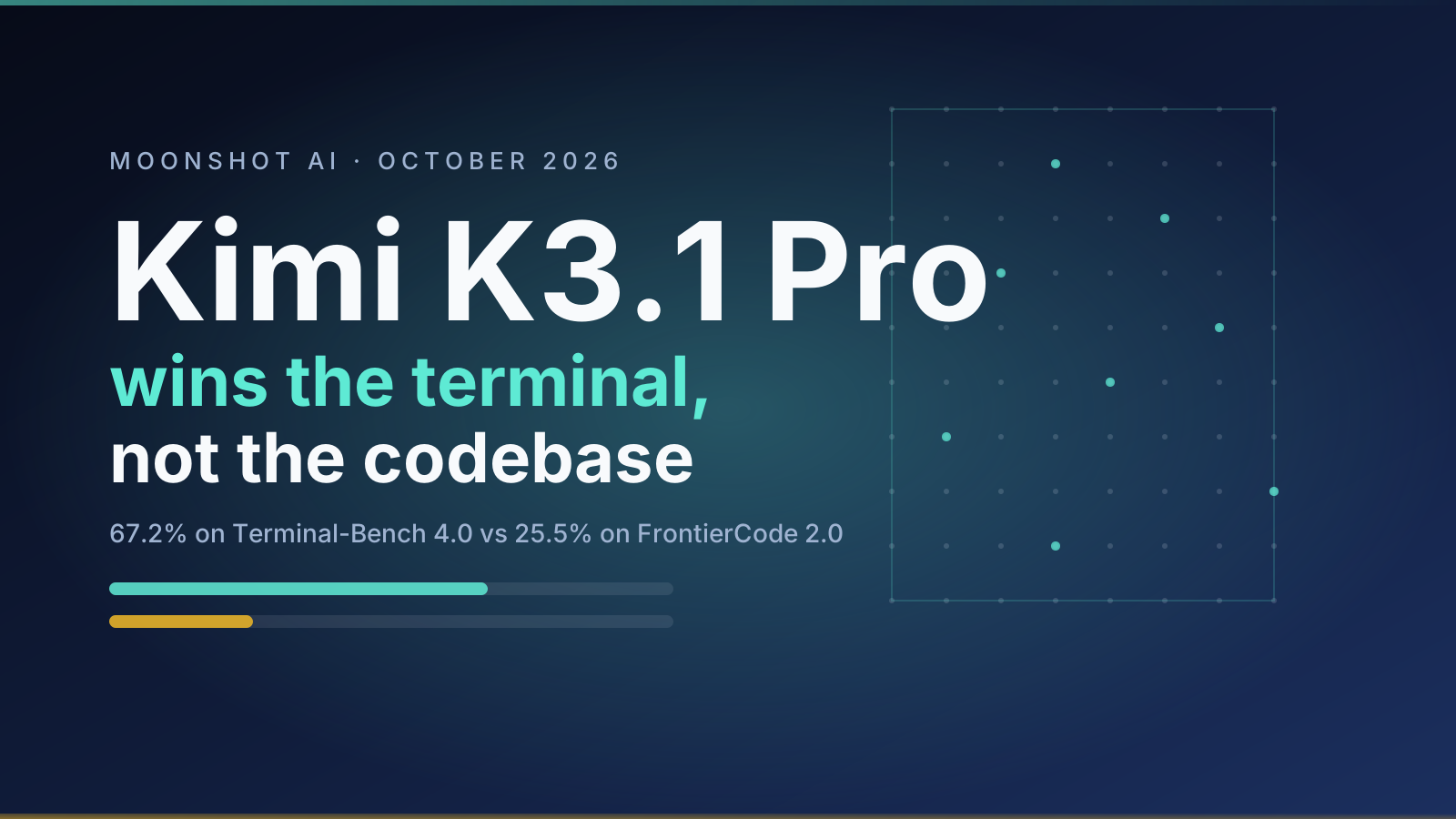
Moonshot AI shipped Kimi K3.1 Pro on October 23, 2026, and the interesting part is not the headline. The headline is that it is the highest-scoring open-weight model on Artificial Analysis's Intelligence Index — 46 on v5.0.1, first among open models. The interesting part is that the strength is concentrated in one place. Kimi K3.1 Pro is the best model in its price class at working inside a terminal, and it is roughly twenty points behind the closed frontier at making a change to a real repository that a maintainer would merge.
Two independent numbers carry that argument. On Terminal-Bench 4.0, Artificial Analysis scores it at 67.2% — above Claude Sonnet 5.5 (63.6%), Claude Opus 5.5 (59.6%) and GPT-6.1 Sol (56.1%) in the same run. On FrontierCode 2.0, Cognition's private benchmark of 132 tasks in real open-source repositories, it scores 25.5% against 46.4% for Claude Opus 5.5. That is a 20.9-point gap on the one benchmark that asks whether an agent's patch would actually be merged.
A note on the numbers you may have seen elsewhere, because two of them are already stale. Artificial Analysis launched K3.1 Pro at 55 on its then-current Intelligence Index, fourth overall and three points behind the leader, and that figure travelled. The index has since been rebased to v5.0.1, with nine evaluations that include FrontierCode 2.0, AA-Briefcase and Terminal-Bench-Science 0.1; on the current index the same model reads 46. The two numbers are not a decline and not a correction — they are different tests, weighted differently. This article uses v5.0.1 and same-runner comparisons throughout, and labels every vendor-reported figure.
What Moonshot actually shipped
Kimi K3.1 Pro is a post-trained version of Kimi K3, not a new pre-training run. Moonshot says it spent substantially more post-training compute, built joint reinforcement learning across hundreds of downstream domains, and rebuilt the surrounding stack — the RL framework, long-context inference, sandbox infrastructure, rollout scheduling — so that each increment of RL bought a predictable return. The architecture is the same skeleton: a MoE with 2.8-trillion-parameter total size and 104B active per token, 896 experts with 16 selected plus two shared, 93 layers, and a 1,048,576-token context window.
One structural change matters for long sessions. Compared with Kimi K3, the full-attention Gated MLA layers are replaced by Gated DeepSeek Sparse Attention: 69 of the 93 layers use Kimi Delta Attention and 24 use Gated DSA. The vision encoder is a 401M-parameter MoonViT-V2, so input is text and images. Weights ship in MXFP4 with MXFP8 activations — quantization-aware training, not a post-hoc 4-bit squeeze — which is why the released checkpoint is MXFP4 rather than BF16.
The weights landed on Hugging Face on November 2, two days ahead of Moonshot's November 4 promise. The licence is a custom Kimi K3.1-Pro License: an MIT-style grant with two conditions, the substantive one being that a company selling “Model as a Service” with more than $20 million in group revenue over any 12 months needs a separate agreement with Moonshot. Products that merely embed the model do not count. That is permissive by the standards of the 2026 open-weight wave, but it is not Apache 2.0, and “open” here means downloadable, not unconditionally free.
There is also a Highspeed variant that Moonshot says runs two to three times faster with identical capabilities, and both models are live on Kimi.ai, Kimi Work, Kimi Code and the Kimi API. The API model ID is kimi-k3.1-pro, and the model card reports every published score at reasoning effort max.
The two numbers that matter
The benchmark story splits cleanly, and the split is the article. On Terminal-Bench 4.0 — realistic, resource-constrained terminal tasks graded by strict task-specific tests — Kimi K3.1 Pro comes first. Artificial Analysis reported 67.2% in its own harness and called it the highest score of any model at launch, up from 12.6% for Kimi K3. The vendor's own number is 65.7%.
On FrontierCode 2.0 the story inverts. The benchmark, built by Cognition with open-source maintainers, runs 132 private tasks in real repositories and grades whether the resulting change is good enough to merge; an attempt that fails a blocking check scores zero. Artificial Analysis runs all 132 tasks three times each with its own Stirrup harness. Kimi K3.1 Pro scores 25.5%. Claude Opus 5.5 scores 46.4%, Claude Sonnet 5.5 41.7%, GPT-6.1 Sol 40.6%.
Put plainly: Kimi K3.1 Pro is excellent at operating a machine and mediocre at changing a codebase well enough that someone else accepts the change. Those are different skills, and the 2026 leaderboard conversation has been sloppy about treating “coding” as one axis.
One harness, four models: Kimi K3.1 Pro vs. the closed tier (%)
All bars: Artificial Analysis Intelligence Index v5.0.1, run by Artificial Analysis with its own Stirrup harness — not vendor numbers. The same seven evaluations feed every model's Intelligence Index score, but the totals are not comparable to the v4.x index quoted in earlier articles on this site. Kimi wins three of the seven outright and loses the four reasoning-heavy ones by double digits.
Same runner, same benchmark: the independent scorecard
The table below is deliberately narrow. Every row comes from Artificial Analysis's Intelligence Index v5.0.1, which means one organization ran one variant of each benchmark on all four models with one harness. That is the only way to subtract one column from another honestly. The vendor numbers are in the next section, separately labelled.
| Benchmark (variant) | Kimi K3.1 Pro | Claude Opus 5.5 | Claude Sonnet 5.5 | GPT-6.1 Sol |
|---|---|---|---|---|
| Terminal-Bench 4.0 | 67.2% | 59.6% | 63.6% | 56.1% |
| AutomationBench-AA | 73.3% | 69.5% | 71.8% | 64.9% |
| FrontierCode 2.0 | 25.5% | 46.4% | 41.7% | 40.6% |
| HLE-Diamond | 37.3% | 67.9% | 53.3% | 58.8% |
| CritPt v2 (Hard Subset) | 49.5% | 68.0% | 59.0% | 69.5% |
| Terminal-Bench-Science 0.1 | 34.3% | 59.0% | 53.3% | 58.1% |
| GDP.pdf | 31.4% | 26.2% | 25.8% | 31.0% |
| AA-Briefcase v1.1 (Elo) | 1674 | 1801 | 1816 | 1555 |
| AA-Omniscience v1.1 (net) | 30 | 48 | 30 | 42 |
| Intelligence Index v5.0.1 | 46 | 59 | 55 | 55 |
| Cost per Index task | $3.68 | $10.04 | $10.02 | $1.27 |
All rows: Artificial Analysis Intelligence Index v5.0.1, independent of the vendors. HLE-Diamond and CritPt v2 are different tests; neither is the full Humanity's Last Exam. AA-Briefcase is an Elo score, not a pass rate, and AA-Omniscience is a net score that penalizes hallucination, so both are incomparable with the percentages above.
The pattern is consistent across the row set. Kimi wins the two tests about doing: terminal work and end-to-end workflow completion. It loses the four tests about knowing and reviewing — hard science reasoning, research-level physics, scientific terminal work, and mergeable code — and it loses them by double digits. The exception that cuts in its favour is document reasoning: 31.4% on GDP.pdf is the best of the four, ahead of GPT-6.1 Sol at 31.0% and both Claude models by about five points.
AA-Briefcase is the most interesting split for anyone who reads spreadsheets for a living. Kimi scores 1674 Elo, which beats GPT-6.1 Sol at 1555 and loses to both Claude models, with Sonnet 5.5 at 1816 and Opus 5.5 at 1801. That is a narrower result than “best open model” suggests: in the same evaluation set it is a mid-table knowledge-work model with a strong document-reasoning component.
Vendor table versus independent run
Moonshot's model card publishes a wide table, and it is more honest than most: it names the harness, notes where competitor scores come from their own blog posts or official leaderboards, and marks internal benchmarks as internal. Four of its rows can be checked directly against Artificial Analysis's independent run, and the result is reassuring.
| Benchmark (variant) | Kimi K3.1 Pro (vendor) | Kimi K3.1 Pro (AA) | Reading |
|---|---|---|---|
| Terminal-Bench 4.0 | 65.7% | 67.2% | Independent run is 1.5 points higher; harnesses differ |
| HLE-Diamond | 39.4% | 37.3% | Vendor run is 2.1 points higher — within noise |
| AutomationBench-AA | 73.3% | 73.3% | Kimi is quoting AA's number, not running its own |
| AA-Briefcase v1.1 (Elo) | 1678 | 1674 | 4 Elo apart — also an AA figure copied across |
Vendor column: Moonshot's Kimi K3.1-Pro model card, all results at reasoning effort max. Independent column: Artificial Analysis Intelligence Index v5.0.1. Terminal-Bench 4.0 is run by Kimi with the Claude Code harness and by AA with Stirrup, so the two scores are different measurements of the same benchmark, not a replication.
The important caveat is in the last two rows: half of the checkable table is Artificial Analysis's work quoted back. That is not dishonest, and more vendors should do it, but it means the model card is partly a mirror. The one place where the two tables disagree in direction is the benchmark that matters most to the launch narrative.
Kimi's table puts Claude Opus 5.5 at 66.4% on Terminal-Bench 4.0 — above its own 65.7% — and that is the comparison most coverage repeated: narrowly second to Opus, ahead of GPT-6 Astra. But that 66.4% is Anthropic's reported maximum, not a run on Kimi's harness. When Artificial Analysis ran both models itself, it got 67.2% for Kimi and 59.6% for Claude Opus 5.5. The direction of the result survives; the margin does not. Cross-vendor tables should be read as a set of estimates, not a race.
What changed from Kimi K3
Kimi K3 was the July 2026 release this site covered in Kimi K3 vs. Fable 5 vs. GPT-5.6 Sol, where it scored 57 on Intelligence Index v4.1 and held first place on a front-end coding arena. That 57 is not comparable to anything in this article: AA has rebased the index more than once since, and v5.0.1 is a different nine-test composite. Cross-article consistency here means naming the version, not carrying the number forward.
What is comparable is the same-runner, same-variant deltas between K3 and K3.1 Pro, both measured by Artificial Analysis on v5.0.1 components. They are not subtle.
| Benchmark (variant) | Kimi K3 | Kimi K3.1 Pro | Change |
|---|---|---|---|
| Terminal-Bench 4.0 | 12.6% | 67.2% | +54.6 points |
| AutomationBench-AA | 58.3% | 73.3% | +15.0 points |
| HLE-Diamond | 26.9% | 37.3% | +10.4 points |
| CritPt v2 (Hard Subset) | 40.5% | 49.5% | +9.0 points |
| GDP.pdf | 22.0% | 31.4% | +9.4 points |
| AA-Briefcase v1.1 (Elo) | 1497 | 1674 | +177 Elo |
| Output price per 1M tokens | $15.00 | $10.00 | −33% |
Both columns from Artificial Analysis's v5.0.1 component runs; K3 values from AA's Kimi K3 comparison page. Prices from Kimi's inference pricing table. Terminal-Bench 4.0 is a harness-sensitive benchmark, but both columns come from the same Artificial Analysis harness, so the +54.6-point jump is a like-for-like comparison of the two models under one runner.
The Terminal-Bench leap is the headline of the release, and it holds up: Artificial Analysis measured 67.2% independently against the vendor's 65.7%, so this is not a self-reported claim that evaporates on a second run. It is also the least transferable gain in the table. Terminal-Bench rewards a model that can drive a shell, read test output and iterate, which is exactly what a large post-training run on agentic trajectories teaches. FrontierCode rewards judgment about design and scope in an unfamiliar repository, which is harder to install with reinforcement learning on verifiable tasks. That gap between “can operate the machine” and “knows what change to make” is the most useful thing this release tells us about where post-training returns are falling.
The Vibe Code Bench flat line
vals.ai runs Vibe Code Bench, which asks models to build web applications from scratch in an OpenHands harness. It is a different question from FrontierCode — greenfield construction versus maintenance in someone else's repository — and it is the benchmark where Kimi K3.1 Pro most clearly fails to improve on its predecessor.
| Model | Vibe Code Bench v1.1 | Cost per test | Tokens per test | Duration |
|---|---|---|---|---|
| Claude Sonnet 5.5 | 92.39% | $19.73 | 116.97M | 1h 01m |
| Claude Opus 5.5 | 90.29% | $35.77 | 112.33M | 1h 36m |
| GPT-6.1 Sol | 88.93% | $6.23 | 21.67M | 1h 15m |
| Kimi K3 | 84.97% | $10.01 | 25.33M | 16m 39s |
| Kimi K3.1 Pro | 84.89% | $7.49 | 28.14M | 50m 29s |
Source: vals.ai Vibe Code Bench v1.1, updated November 9, 2026; OpenHands harness for every row. Cost and token figures are vals.ai's measurements at list prices.
Read the last two rows together. K3.1 Pro scores 84.89% against Kimi K3's 84.97% — a 0.08-point regression, which is noise — while spending 28.14M tokens instead of 25.33M and taking 50 minutes 29 seconds instead of 16 minutes 39 seconds. The cost per test fell from $10.01 to $7.49, but that is the one-third price cut, not efficiency: it burned 11% more tokens to produce the same quality more slowly.
And the comparison that stings is GPT-6.1 Sol: 88.93% at $6.23 per test. The OpenAI model is four points better on greenfield web apps and 17% cheaper per test. Kimi's advantage over it is Terminal-Bench and workflow completion, not building the app.
Pricing, and the cache trap
At list price, Kimi K3.1 Pro is priced like a mid-tier frontier model: $2.00 per million input tokens and $10.00 per million output tokens, flat across the full 1,048,576-token context, with cache hits at $0.20. Cache writes are billed separately by TTL, at five minutes or one hour, and batch inference runs at 60% of standard. That is one-third below Kimi K3 on all three rates and, notably, the same input and output price as Claude Sonnet 5.5 and GPT-6.1 Sol.
| USD per 1M tokens | Kimi K3.1 Pro | Kimi K3 | Claude Sonnet 5.5 | GPT-6.1 Sol | Claude Opus 5.5 |
|---|---|---|---|---|---|
| Input | $2.00 | $3.00 | $2.00 | $2.00 | $4.00 |
| Output | $10.00 | $15.00 | $10.00 | $10.00 | $20.00 |
| Cache read | $0.20 | $0.30 | $0.10 | $0.10 | $0.20 |
| Context window | 1,048,576 | 1,048,576 | 1M | 1M | 1M |
| Cost per Index task | $3.68 | — | $10.02 | $1.27 | $10.04 |
Kimi rates from platform.kimi.ai, verified November 10, 2026; Claude and OpenAI rates and all cost-per-task figures from Artificial Analysis model comparisons (v5.0.1). Kimi K3's cache-write rates are not published on the pricing page consulted, so they are omitted rather than guessed; the dash in the cost row means no cost-per-task figure is published for K3 under v5.0.1.
The headline number looks like a bargain against Opus 5.5 and a wash against Sonnet 5.5. The bill does not, because agent sessions are dominated by cache reads. Sonnet 5.5 and GPT-6.1 Sol charge $0.10 per million cached tokens; Kimi charges $0.20. On the cache-heavy agent hour this site has used since the DeepSeek V4 Pro teardown — 31.0M cache reads, 175K uncached input, 107K output — Kimi K3.1 Pro costs $7.62, against $4.52 for either Sonnet 5.5 or GPT-6.1 Sol. It is 1.7 times the bill for the same hour, from a model with the same headline price.
Against its own predecessor it is a genuine cut: the same hour on Kimi K3 is $11.43, so the 33% price reduction shows up almost exactly. Against Claude Opus 5.5, whose $4/$20 card and $0.20 cache read produce $9.04, it is cheaper for the same hour — but Opus is 13 points higher on the Intelligence Index, so that comparison is a quality trade, not a bargain. The lesson is the one this blog keeps relearning: price per token is not price per task, and price per task is not price per finished job.
Cost of one cache-heavy agent hour (USD, list prices)
Modelled, not measured: 31.0M cache reads, 175K uncached input tokens and 107K output tokens, multiplied by each model's published per-million rates. Cache-write charges, tools and retries are excluded. The point is the ranking at the cache-read rate, which is the line item that dominates a long agent session.
Where it sits against Claude and GPT
The tier mapping is unusually clean because the price card is identical. At $2/$10, Kimi K3.1 Pro competes with Claude Sonnet 5.5 and GPT-6.1 Sol, not with Opus or the Fable line. Against Sonnet 5.5 it wins Terminal-Bench 4.0 (67.2% to 63.6%), AutomationBench-AA (73.3% to 71.8%) and GDP.pdf (31.4% to 25.8%); it loses FrontierCode 2.0 by 16.2 points, HLE-Diamond by 16 points and Terminal-Bench-Science 0.1 by 19 points. Against GPT-6.1 Sol it wins three of the seven percentage benchmarks and loses the economics: $3.68 per Index task against $1.27, on 72.2K output tokens per task versus 67.8K and 32 tokens per second versus 57.
The practical version: Kimi K3.1 Pro is the right model for a terminal agent that has to finish a multi-step task in a known environment, and the wrong model for a coding agent that has to decide what to change in an unfamiliar repository. It is also slow enough that interactive use is unpleasant — Artificial Analysis measures 37.5 minutes per Index task, 159.63 seconds to the first answer token, and 32 tokens per second. A 50-minute Vibe Code Bench run against K3's 17 minutes is consistent with that.
Against Opus 5.5 it is a value play, not a quality play: 46 versus 59 on the Intelligence Index, $3.68 versus $10.04 per task. If a workload is terminal-shaped and the output is checkable, that trade is easy to defend. If the output is code that another engineer has to review, it is not.
What the benchmarks do not say
There is no SWE-bench Verified number for Kimi K3.1 Pro, and that is not an omission by Moonshot. vals.ai stopped running SWE-bench Verified on new releases because the benchmark saturated: as of its final September 1, 2026 update, Claude Opus 5 topped it at 97.00% and Kimi K3 sat eighth at 93.40% for $0.76 per test. When the ceiling is 97%, a new model has nowhere to show progress, so the field moved to harder, more expensive evaluations like FrontierCode 2.0 and Terminal-Bench 4.0. Anyone quoting a SWE-bench Verified score for this model is quoting something that does not exist.
The other caution is about variants. Moonshot's card reports HLE-Full at 51.1% without tools and 70.0% with tools; Artificial Analysis reports HLE-Diamond at 37.3%. Those are three different tests. GPQA Diamond at 94.2% is vendor-reported only in the sources consulted here, and GPQA is close to saturated for every frontier model, so it tells you little. The benchmark with the most decision value for buyers — FrontierCode 2.0 — is also the one where the model looks weakest, which is exactly when a launch post is most tempted to change the subject.
Finally, the deployment constraint. A 2.8-trillion-parameter model, even in MXFP4, is a multi-GPU server rather than a workstation, and the licence's Model-as-a-Service threshold means a hosted inference business needs a commercial agreement above $20 million in revenue. For most teams the realistic path is the first-party API, where the price and cache numbers above apply.
The verdict
Kimi K3.1 Pro is the best open-weight model of November 2026 on the composite that most people cite, and it earns that title with a genuine, independently reproduced jump in agentic terminal work. It is also a narrower model than the title implies: flat against its predecessor on greenfield web apps, 21 points behind Opus on mergeable code, and more expensive per cached agent hour than the closed mid-tier it is priced against.
The honest summary is that Moonshot bought a large, real improvement in the one capability that post-training can verify cheaply — can the model operate the machine and finish the task — and did not buy the judgment that makes a patch worth merging. If your workload looks like Terminal-Bench, this is the best value in the class. If it looks like FrontierCode, the $2/$10 price card is a distraction from a 20-point quality gap, and the closed tier is still worth what it charges.